

Artificial intelligence is everywhere — and yet, for most people, it remains genuinely difficult to explain. It recommends your next Netflix show, flags fraudulent transactions on your bank account, helps doctors detect cancer in scans, and writes emails on your behalf. But ask someone to define it clearly, and the answer often dissolves into vague gestures at robots and science fiction.
That gap between ubiquity and understanding matters — especially now. AI is no longer a technology that only engineers and researchers need to understand. As tracked in Stanford University’s annual AI Index Report, it is reshaping marketing, healthcare, education, finance, and virtually every other sector. Making informed decisions about how to use it, manage it, and think about it requires a solid grounding in what it actually is.
This guide provides exactly that — a clear, jargon-light explanation of what artificial intelligence is, how it works, the main types that exist, real-world examples across industries, the current limitations, and the ethical questions that matter most as AI continues to develop.
The Simple Definition: Artificial intelligence (AI) is the ability of a computer system to perform tasks that would normally require human intelligence — such as recognizing patterns, understanding language, making decisions, and learning from experience. AI systems do not think like humans, but they can mimic specific cognitive functions well enough to automate complex tasks at massive scale.
Table of Contents
What Is Artificial Intelligence? The Full Explanation
The term “artificial intelligence” was coined in 1956 by computer scientist John McCarthy, who defined it as “the science and engineering of making intelligent machines.” That original definition still holds, but the field has expanded enormously in scope and sophistication since then.
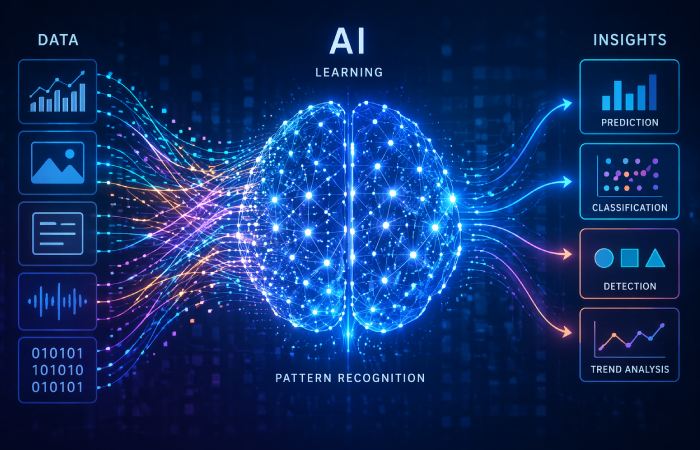
At its core, AI is about teaching machines to do things that have historically required human cognition. The key word is “teaching” — most modern AI is not explicitly programmed with rules. Instead, AI systems learn from data. They are exposed to enormous amounts of examples, extract patterns from those examples, and use those patterns to make predictions or decisions about new situations.
Think about how a child learns to recognize a dog. They are not given a rulebook that says “four legs, fur, tail, barks.” They are shown many examples of dogs — in different sizes, colors, and contexts — until their brain builds an internal model that can identify a new dog it has never seen before. Modern AI learns in a structurally similar way, except it processes millions of examples rather than hundreds, and it does so at computational speed.
The Difference Between AI, Machine Learning, and Deep Learning
These three terms are frequently used interchangeably, but they have a specific relationship:
- Artificial Intelligence (AI): The broadest term — any technique that enables machines to mimic human intelligence. Includes both rule-based systems and learning systems.
- Machine Learning (ML): A subset of AI. Specifically refers to systems that learn from data rather than being explicitly programmed. Most modern AI is machine learning-based.
- Deep Learning (DL): A subset of machine learning that uses artificial neural networks with many layers (hence “deep”) to learn from very large datasets. Deep learning powers most of the recent breakthroughs — image recognition, natural language processing, generative AI.
The relationship is nested: all deep learning is machine learning, and all machine learning is AI — but not all AI is machine learning, and not all machine learning is deep learning.
The Main Types of Artificial Intelligence
AI is not a single technology — it is a family of approaches, each suited to different tasks. Understanding the main categories helps clarify what AI can and cannot currently do.
By Capability: Narrow AI vs. General AI vs. Superintelligence
- Narrow AI (Weak AI): All AI that currently exists falls into this category. Narrow AI is designed to perform a specific task — and it can do that task extremely well, often better than humans. But it has no ability to transfer that skill to a different domain. A chess-playing AI cannot drive a car. A medical image recognition AI cannot write poetry. Every AI system you interact with today is narrow AI.
- Artificial General Intelligence (AGI): A theoretical form of AI that would match human cognitive ability across all domains — reasoning, creativity, emotional intelligence, learning new skills, applying knowledge from one field to another. AGI does not currently exist. It is a research goal, but there is no scientific consensus on when or whether it will be achieved.
- Artificial Superintelligence (ASI): Hypothetical AI that would surpass human intelligence across all dimensions. Exists only in theory and in science fiction. Both AGI and ASI are topics of significant philosophical and safety debate in the AI research community.
By Approach: The Main AI Techniques
- Supervised learning: The most common form of machine learning. The AI is trained on labeled data — examples where the correct answer is known. It learns to map inputs to outputs. Used in spam detection, image classification, price prediction, and most business AI applications.
- Unsupervised learning: The AI is given unlabeled data and must find its own structure and patterns. Used in customer segmentation, anomaly detection, and exploratory data analysis.
- Reinforcement learning: The AI learns through trial and error, receiving rewards for correct actions and penalties for incorrect ones. Used to train game-playing AI (like AlphaGo), robotics, and autonomous systems.
- Natural Language Processing (NLP): Enables AI to understand, generate, and interact using human language. Powers chatbots, voice assistants, translation tools, and large language models like GPT.
- Computer Vision: Enables AI to interpret and understand images and video. Powers facial recognition, medical imaging analysis, autonomous vehicles, and quality control systems.
- Generative AI: A category of AI that can generate new content — text, images, audio, video, code — rather than simply analyzing or classifying existing content. Includes large language models, image generation models, and multimodal systems.
How Does AI Actually Work? A Plain-English Explanation
Most people understand conceptually that AI “learns from data” — but the actual mechanism is worth understanding at a basic level, because it explains both AI’s remarkable capabilities and its significant limitations.
The Training Process
Training an AI model involves three fundamental elements:
- Data: AI learns from data — often enormous quantities of it. An image recognition model might be trained on millions of labeled photographs. A language model might be trained on hundreds of billions of words of text. The quality, diversity, and size of the training data directly determines the quality of the resulting model.
- The model architecture: A mathematical structure (most commonly a neural network) through which data is processed. The model has millions or billions of adjustable parameters — numerical weights that determine how it processes and responds to input.
- The training algorithm: A process that repeatedly exposes the model to training data, compares its outputs to the correct answers, calculates the error, and adjusts the model’s parameters slightly to reduce that error. This process — called gradient descent — runs millions of times until the model’s performance converges on an acceptable level.
What Neural Networks Are
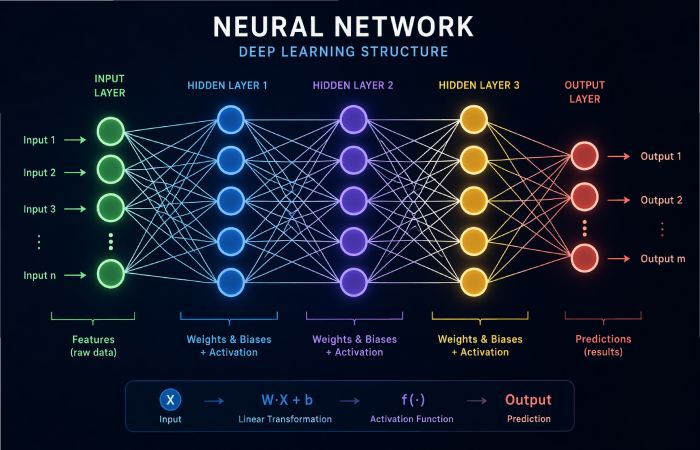
Neural networks are the mathematical architecture underlying most modern AI. They are loosely inspired by the structure of the human brain — layers of interconnected nodes (artificial neurons) where each connection has a numerical weight. Data flows through these layers, being transformed at each step, until the network produces an output.
Deep learning networks have many layers — sometimes hundreds — which allows them to learn increasingly abstract features. Early layers might detect simple patterns (edges in an image). Middle layers combine those into shapes (eyes, wheels). Later layers combine those into complex objects (faces, cars). This hierarchical learning is what makes deep learning so powerful for complex pattern recognition tasks.
What AI Does Not Do
One of the most important things to understand about how AI works is what it does not do. AI does not reason in the way humans do. It does not understand context the way humans do. It does not have beliefs, desires, consciousness, or genuine comprehension. What it does is find patterns in training data and apply those patterns to new inputs — extraordinarily well, at scale, but within the bounds of what its training has prepared it for.
Real-World Examples of AI Across Industries
AI is not a single product or platform — it is a set of capabilities that are being applied across virtually every sector. Here are some of the most significant real-world applications:
Healthcare
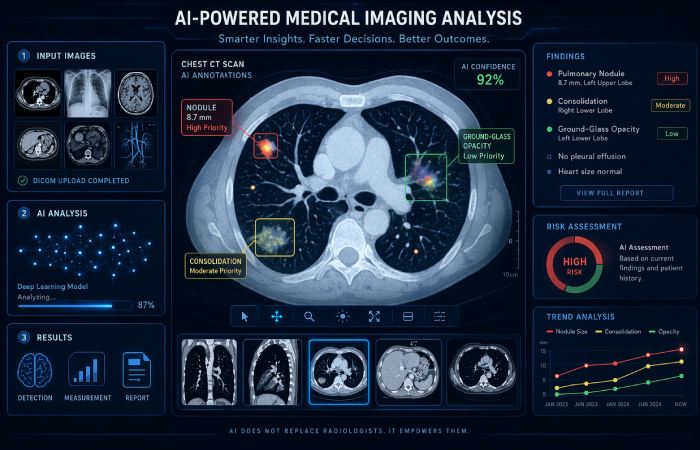
- Medical imaging analysis: AI models trained on millions of scans can detect early-stage cancers, diabetic retinopathy, fractures, and other conditions in X-rays, MRIs, and CT scans — often matching or exceeding specialist radiologist accuracy.
- Drug discovery: AI models can analyze molecular structures and predict how candidate compounds will interact with biological targets, accelerating drug development timelines from years to months.
- Clinical documentation: AI transcribes and summarizes physician-patient conversations, reducing the administrative burden on clinicians and allowing them to spend more time on patient care.
- Predictive health analytics: Hospital AI systems analyze patient data to predict deterioration, sepsis risk, and readmission likelihood — enabling earlier intervention.
Marketing and Business
- Personalization engines: AI analyzes individual user behavior, preferences, and context to deliver personalized product recommendations, content, and offers — driving the recommendation systems at Amazon, Netflix, Spotify, and virtually every major consumer platform.
- Customer service automation: AI-powered chatbots and voice systems handle millions of customer interactions daily — answering questions, resolving issues, and routing complex cases to human agents.
- Content generation: Large language models generate first drafts of marketing copy, product descriptions, email campaigns, and social media posts at a fraction of the time and cost of human-only production.
- Predictive analytics: AI models forecast demand, customer churn, campaign performance, and market trends — enabling data-driven decisions at a scale and speed that was previously impossible.
- Fraud detection: Financial AI systems analyze transaction patterns in real time, flagging anomalies that indicate fraud with a precision that rule-based systems cannot match.
Transportation
- Autonomous vehicles: Self-driving car systems use computer vision, lidar, radar, and AI decision-making to perceive the driving environment and navigate without human input.
- Traffic optimization: AI systems analyze real-time traffic data to optimize signal timing, reduce congestion, and improve emergency vehicle routing.
- Predictive maintenance: AI analyzes sensor data from vehicles and aircraft to predict component failures before they occur, reducing downtime and improving safety.
Education
- Adaptive learning platforms: AI tutoring systems adjust the difficulty, pacing, and content of learning materials based on individual student performance, providing a personalized educational experience at scale.
- Automated grading: AI systems grade essays, code submissions, and mathematical proofs with increasing accuracy, freeing educator time for higher-value instruction.
- Language learning: Apps like Duolingo use AI to personalize vocabulary, grammar, and conversation practice based on each learner’s progress and error patterns.
The Key Benefits of Artificial Intelligence
- Speed and scale: AI can process and analyze data at a speed and volume that is impossible for humans. A medical AI can review thousands of scans in the time it takes a radiologist to review one. A fraud detection AI can evaluate millions of transactions per second.
- Consistency and accuracy: Human performance varies with fatigue, mood, and attention. AI systems perform consistently at the same level regardless of the time of day or volume of work — which is particularly valuable in high-stakes, high-volume applications.
- Pattern recognition in complex data: AI excels at finding patterns in datasets too large and complex for human analysis — identifying correlations in genomic data, market behavior, and customer action that would be invisible without machine assistance.
- Automation of repetitive tasks: AI frees human workers from repetitive, time-consuming tasks — data entry, document processing, routine customer inquiries, basic quality control — allowing human attention to focus on higher-value, judgment-intensive work.
- Personalization at scale: AI makes it possible to deliver genuinely personalized experiences to millions of individuals simultaneously — something that would require an impossibly large human workforce to replicate.
- Continuous improvement: Many AI systems improve over time as they are exposed to more data — a feedback loop that compound benefits as the system accumulates experience.
The Current Limitations of AI: What It Cannot Do
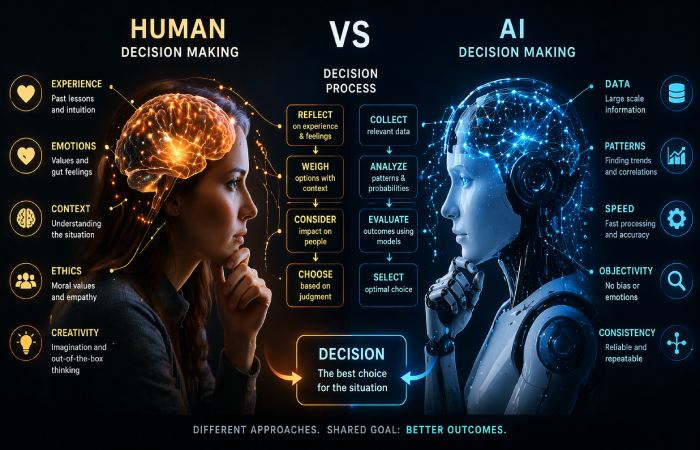
Honest AI literacy requires understanding the limitations as clearly as the capabilities. Current AI has significant constraints that are important to understand — especially as AI tools are integrated into high-stakes decisions.
- AI can be confidently wrong (hallucination): Large language models in particular can generate plausible-sounding but entirely incorrect information — a phenomenon called hallucination. They do not “know” what they do not know; they generate statistically probable outputs regardless of factual accuracy.
- AI reflects the biases in its training data: AI learns from human-generated data — which contains human biases. AI systems trained on biased data reproduce and sometimes amplify those biases in their outputs. This has been documented in facial recognition (lower accuracy on darker skin tones), hiring tools (bias against certain demographic groups), and criminal justice risk assessment tools.
- AI lacks genuine understanding and context: Current AI does not understand language, images, or situations the way humans do. It operates on statistical patterns. This means it can fail unpredictably in situations that fall outside the distribution of its training data.
- AI cannot reliably reason about novel situations: Human intelligence is characterized by the ability to transfer knowledge across domains and reason about genuinely new situations. Current AI is brittle in this regard — it can fail dramatically when faced with inputs meaningfully different from its training examples.
- AI has no ethical judgment: AI systems do not have values, judgment, or moral understanding. They optimize for the objective they were given, which may not align with broader human values. An AI optimized for engagement maximization may promote outrage and misinformation because those reliably drive engagement.
- AI is computationally expensive: Training large AI models requires enormous computational resources — and significant energy consumption. The environmental and financial costs of AI at scale are a growing concern.
AI Ethics: The Questions That Cannot Be Ignored
AI development raises a set of profound ethical questions that are active areas of policy debate, regulatory development, and public concern. Anyone working with or affected by AI should have a basic familiarity with these issues.
- Bias and fairness: If AI systems trained on biased data make biased decisions in hiring, lending, healthcare, and criminal justice — who is responsible, and how should it be corrected?
- Privacy and surveillance: AI makes facial recognition, behavioral prediction, and mass surveillance far more powerful and affordable. How should societies balance the utility of these tools against individual privacy rights?
- Transparency and explainability: Many AI systems — particularly deep learning models — are black boxes. They produce outputs without being able to explain their reasoning. When AI makes a consequential decision about a person, do they have a right to understand why? The NIST AI Risk Management Framework addresses these explainability and accountability standards in detail.
- Autonomous weapons: AI-enabled autonomous weapons systems capable of identifying and engaging targets without human oversight raise profound questions about accountability, international law, and the future of conflict.
- Employment displacement: AI automation will eliminate some categories of work and create others. How should societies manage this transition — and who bears the cost?
- Concentration of power: The most capable AI systems are currently developed by a small number of very large technology companies. What are the implications of that concentration for democratic accountability, market competition, and geopolitical balance?
Frequently Asked Questions (FAQ)
The most common questions about artificial intelligence.
What is the simplest definition of artificial intelligence?
Artificial intelligence is the ability of a computer system to perform tasks that normally require human intelligence — such as recognizing images, understanding language, making decisions, and learning from experience. In practice, AI systems learn from large amounts of data rather than being explicitly programmed with rules, allowing them to handle complex tasks that traditional software cannot.
What is the difference between AI and machine learning?
Artificial intelligence is the broad field of making machines capable of intelligent behavior. Machine learning is a specific approach within AI where systems learn from data rather than following explicitly programmed rules. Think of AI as the goal and machine learning as one of the main methods used to achieve it. Most practical AI applications today use machine learning — and most cutting-edge machine learning uses deep neural networks, which is known as deep learning.
Is artificial general intelligence (AGI) real?
No — AGI does not currently exist. All AI systems that exist today are narrow AI: highly capable within their specific domain, but unable to transfer that capability to other areas. AGI — AI that matches human cognitive ability across all domains — is a theoretical research goal. There is significant debate in the AI research community about whether it is achievable, how long it might take, and what the implications would be. Claims that any current system constitutes AGI are not supported by the scientific consensus.
Can AI think for itself?
No — not in any meaningful sense of the word “think.” Current AI systems do not have consciousness, intentions, beliefs, or self-awareness. They are sophisticated pattern-matching systems that generate outputs based on statistical patterns learned from training data. When a language model produces a response that seems thoughtful or insightful, it is generating statistically probable sequences of words — not reasoning from understanding. This distinction is important and often obscured by the anthropomorphizing language used to describe AI systems.
Will AI replace human jobs?
AI will automate specific tasks and transform many jobs — but the historical pattern of technological automation suggests that new categories of work tend to emerge as others are displaced. The honest answer is that the net employment impact of AI is uncertain and will vary significantly by sector, skill level, geography, and policy response. Tasks most at risk are those involving routine, predictable, well-defined processes — data processing, basic content creation, customer service scripting. Tasks most resilient are those requiring complex judgment, creativity, emotional intelligence, and physical dexterity in unstructured environments.
What is generative AI?
Generative AI refers to AI systems that can create new content — text, images, audio, video, code, or other outputs — rather than simply analyzing or classifying existing content. Large language models like GPT-4 and Claude are examples of generative AI that produce text. Image generation models like DALL-E and Midjourney produce images from text descriptions. Generative AI represents a significant shift from earlier AI paradigms, because it creates rather than just categorizes — which opens both powerful new applications and significant new risks around misinformation and intellectual property.
Final Thoughts: AI Literacy Is Now a Core Competency
Artificial intelligence is not a passing trend or a distant future technology. It is a present-day reality that is already reshaping industries, professions, and daily life at a pace that shows no sign of slowing.
Understanding what AI is — how it works, what it can do, what it cannot do, and what the important questions around its use are — is increasingly a prerequisite for informed participation in professional and civic life. You do not need to be a data scientist to have a meaningful understanding of AI. But you do need a solid mental model to evaluate AI tools, interpret AI outputs, make good decisions about AI adoption, and engage meaningfully with the policy debates that will shape how this technology develops.
The most important thing to remember: AI is a tool — a remarkably powerful one, but a tool nonetheless. Its value depends entirely on the quality of the questions it is asked, the data it is trained on, and the judgment of the humans who use and govern it.