

Last Updated: June 25, 2026
If your business depends on customers in a specific city or region, showing up in local search results is not optional. It is the difference between your phone ringing and your competitor’s phone ringing. Local SEO is the practice of optimizing your online presence so that nearby customers find you when they search for what you offer. And the good news is that you do not need a massive budget or a marketing degree to get started.
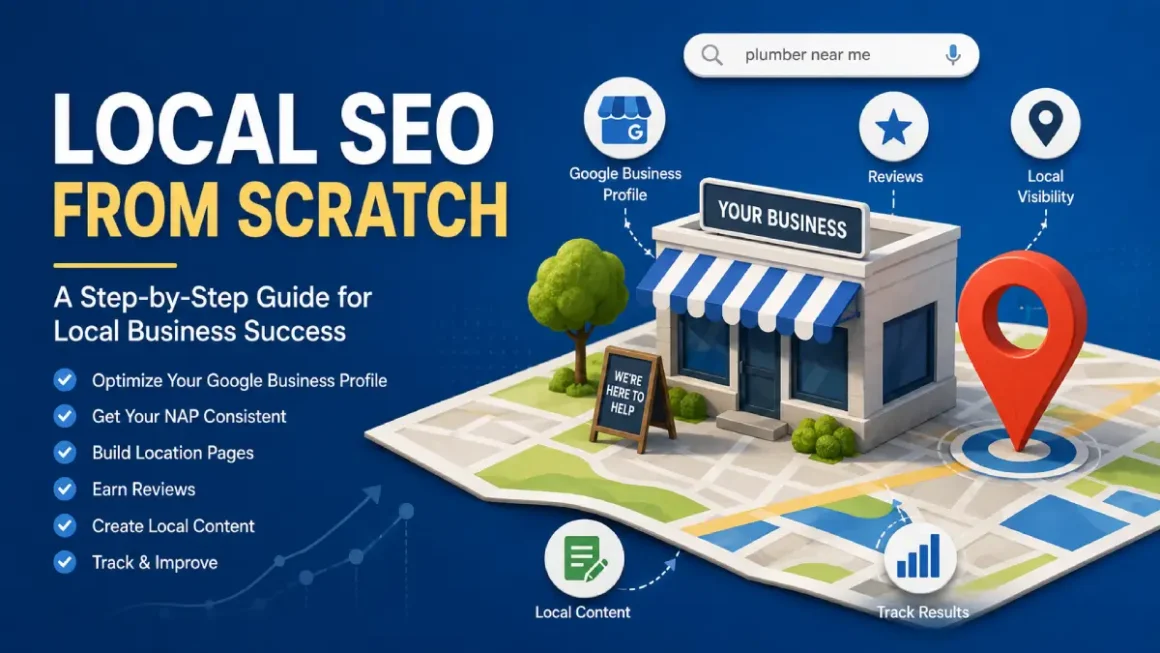
This guide walks you through how to build a local SEO strategy from the ground up, step by step.
Table of Contents
Start With Your Google Business Profile
If you have not claimed your Google Business Profile yet, that is your first move. Full stop.
This free listing is one of the most powerful tools available to local businesses. When someone searches for “plumber near me” or “IT support in [city],” the results that appear in that map section at the top of the page are powered by Google Business Profiles.
Here is what you need to do to set yours up properly:
- Claim and verify your listing. Google will send a postcard or allow phone/email verification depending on your business type.
- Fill out every field. Business name, address, phone number, website, hours, service areas, business category. All of it.
- Write a clear business description. Keep it focused on what you do and who you serve. This is not the place for a sales pitch.
- Add real photos. Interior, exterior, team, work examples if applicable. Listings with photos consistently get more clicks than those without.
- Choose the right categories. Your primary category should be as specific as possible. You can add secondary categories too.
Once your profile is live, keep it active. Post updates regularly, respond to every review (yes, even the negative ones), and update your hours whenever they change.
Get Your NAP Consistent Everywhere
NAP stands for Name, Address, and Phone Number. It sounds basic, but inconsistent business information across the web is one of the most common reasons local businesses struggle to rank.
Search engines cross-reference your business information across dozens of directories and websites. If your address is listed one way on your website, a different way on Yelp, and yet another way on a business directory, it creates confusion. Google wants to serve users accurate information, so inconsistency can quietly work against you.
Go through the major directories and make sure everything matches exactly:
- Google Business Profile
- Yelp
- Facebook Business Page
- Apple Maps
- Bing Places
- Industry-specific directories relevant to your field
Use the same format every time. If your address uses “Suite” on your website, do not abbreviate it as “Ste.” on your Yelp listing. The details matter.
Build Location-Specific Pages on Your Website
Your website is your home base, and it needs to reflect where you do business.
If you serve one city, make sure your homepage clearly states that. If you serve multiple cities or regions, consider building individual service area pages for each location. These pages give you a real opportunity to show up in search results across a wider geography.
A good location page should include:
- The city or region name naturally woven into the content (not stuffed in awkwardly)
- A description of the services you offer in that area
- Relevant details that are specific to that location when possible
- A clear call to action
Avoid copying and pasting the same content across multiple location pages and just swapping out the city name. Search engines recognize that tactic and it can hurt more than it helps. Put in the effort to make each page genuinely useful.
Optimize Your Website for Local Keywords
Keyword research for local SEO does not have to be complicated. Think about what your ideal customer would actually type into Google when they need what you offer.
For a roofing contractor in Lancaster, PA, that might look like:
- “roof repair Lancaster PA”
- “roofing contractor near me”
- “residential roofing company Lancaster”
Once you identify your target keywords, work them naturally into your website. That includes your page titles, meta descriptions, headers, body copy, and image alt text. The key word there is naturally. Writing for humans first and search engines second will always serve you better than stuffing keywords into every sentence.
Also pay attention to your page titles and meta descriptions. These are the lines of text that appear in search results before someone clicks through. They should be clear, accurate, and include your primary keyword and location when it makes sense.
Build Local Citations
A citation is any mention of your business’s name, address, and phone number on another website. You do not need a link back to your site for it to count as a citation. Just the mention itself carries weight.
Start by submitting your business to the major data aggregators. From there, look for local directories, industry-specific directories, and Chamber of Commerce listings in your area. The goal is to build a broad, consistent footprint across the web.
This is not a task you need to complete in one afternoon. Build citations consistently over time and focus on quality sources over sheer volume.
Make Reviews Part of Your Routine
Online reviews are one of the most significant factors in local search rankings, and they directly influence whether someone chooses to call you or not.
The businesses that consistently show up at the top of local results tend to have more reviews, more recent reviews, and higher average ratings. That is not a coincidence.
The simplest way to get more reviews is to ask. After completing a job or service, follow up with the customer and make it easy for them to leave a review. Send a direct link to your Google review page if you can. Most satisfied customers are happy to leave a review when the process is simple.
When reviews come in, respond to them. Thank customers for positive feedback. Address negative reviews calmly and professionally. How you respond to a bad review tells potential customers a lot about how you run your business.
Create Content That Speaks to Your Community
Content marketing and local SEO overlap more than most people realize. Writing blog posts or articles that speak directly to your local audience is one of the more underutilized strategies available to small businesses.
This does not mean writing generic posts about your industry. It means writing content that connects your expertise to your geography.
Some examples:
- A heating and cooling company could write about how extreme winter temps in their region affect HVAC systems
- A landscaper could cover the best plants and grass types for their local climate
- An IT company could address cybersecurity concerns that are relevant to the types of businesses in their city
This kind of content builds authority, earns local links, and signals to search engines that you are genuinely engaged with your community.
Track What Is Working
You cannot improve what you are not measuring. At minimum, make sure Google Analytics and Google Search Console are set up on your website. These free tools will show you how people are finding your site, what search terms are driving traffic, which pages are performing well, and where people are dropping off.
On the Google Business Profile side, pay attention to the insights dashboard. It will show you how many people viewed your listing, how many clicked for directions, and how many called directly from the listing.
Check these numbers regularly and look for patterns. When something is working, do more of it. When something is not, adjust.
Give It Time
This is the part most businesses do not want to hear, but it is important. Local SEO is not a one-time fix. It is an ongoing process that builds momentum over time.
You will not dominate your local search results in a week. But businesses that stay consistent, keep their information accurate, earn reviews regularly, and put out useful content will almost always see meaningful improvement within a few months. And once you build that presence, it compounds. The work you do today keeps paying off months down the road.
Starting from scratch can feel overwhelming. But if you take it one step at a time, focusing on the fundamentals first, you will be in a much stronger position than most of your competitors who are either ignoring local SEO entirely or dabbling in it inconsistently.
The opportunity is there. You just have to show up for it.