

Last Updated: May 1, 2026
Everyone’s selling you the dream of a smart home. Lights that obey your voice. Doors that unlock themselves. Appliances that know your schedule better than you do.
Here’s what they don’t mention: most people who buy their first smart home device in India use it enthusiastically for about three weeks — then forget it exists.
Not because the tech is bad. Because they bought the wrong thing first, set it up on a weak Wi-Fi signal, and got frustrated before the habit formed.
The home tech world in India is genuinely worth building — but only if you go in the right order. This guide is that order.
Table of Contents
Quick Summary
- India’s smart home market is heading toward $6.97 billion by 2026 — and prices have dropped enough that ordinary households can actually participate.
- The best place to start is not with the most exciting gadget. Why not get your Wi-Fi up and running? Everything else depends on it.
- Smart bulbs, a single smart plug, and a voice speaker under ₹5,000 together will tell you whether smart home living suits you — before you spend more.
- Data privacy is a real concern, not just paranoia. A few simple settings changes can reduce your exposure significantly.
- The home tech world rewards patience. Buy slowly, learn what you actually use, and expand from there.
So What Exactly Is the “Home Tech World”?
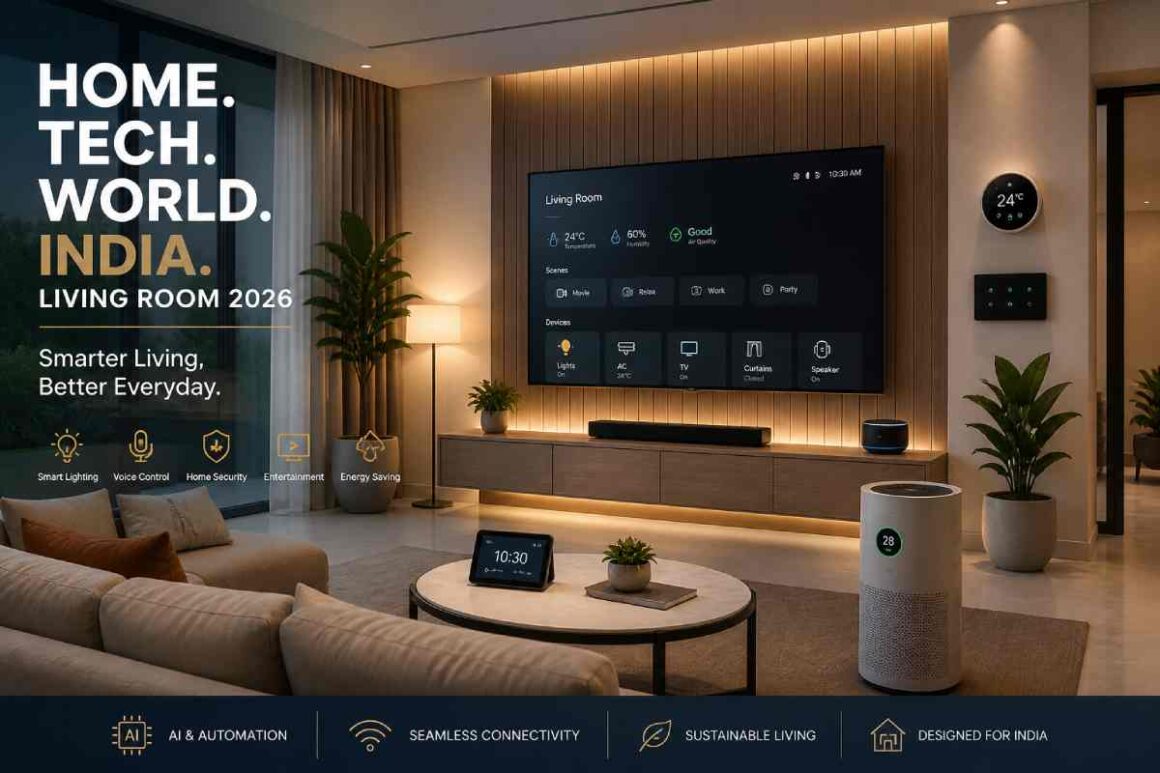
No jargon: the home tech world is just your home, but with things connected to the internet so you can control them without getting up, or without being home at all.
Your lights turn on before you walk in. Your geyser switches off when it’s been running too long. Your front door tells you someone rang the bell while you were in a meeting. Your electricity app shows you that the old refrigerator in the kitchen is eating 40% of your monthly units.
None of this requires pulling wires or calling an electrician — at least not for most of it. That’s what changed. The devices got simpler.
Fortune Business Insights reported that the overall smart home market worldwide was worth USD 147.52 billion in 2025 and is expected to hit USD 848.47 billion by 2034. Even in India, it is estimated to be worth USD 6.97 billion by 2026 alone. Not hype -this is what happens when Smartphone penetration goes beyond 750 million users and 5G starts arriving in cities like Nagpur, Coimbatore and Indore.
Who Actually Benefits From Home Tech in India Right Now?
I want to be direct here because most smart home content ignores this question entirely.
People who genuinely get value from it:
- Families with elderly parents at home alone during work hours. Motion sensors, fall alerts, and camera access give real peace of mind — not convenience, actual safety.
- Frequent travellers who want to monitor their flat. A ₹3,500 camera with remote access is cheaper than a security agency and works 24/7.
- Households with high electricity bills. A smart energy monitor attached to your main board will show you — often within the first week — that one old appliance is costing you ₹800–₹1,200 extra per month.
- New homeowners or those mid-renovation. This is the best time to set things up properly because you can plan Wi-Fi placement and smart switch wiring from scratch.
- Renters in newer societies. Many modern apartments now come with partial smart infrastructure already installed — smart doorbells, common area cameras, app-controlled gate access.
People who should wait or think carefully:
- Anyone with unreliable internet. Seriously — fix connectivity first. Smart devices on a flaky connection are maddening.
- Are renters in older buildings who would have to change the wiring. Most landlords will say no, and you should not try it. Use only plug and play devices.
- Households where not everyone is comfortable with apps. If your parents or in-laws will be using these systems, factor in the learning curve honestly. A device nobody uses is just money spent.
The Core Categories: What’s in India’s Home Tech World and What It Costs
Here‘s a practical breakdown of what‘s available, what it does, and what you‘ll realistically spend:
| Device Type | What It Actually Does for You | Realistic India Cost |
| Smart Bulbs | Schedule lights, change colours, control via voice or app | ₹800–₹2,500 per bulb |
| Smart Plugs | Turn any existing appliance smart with remote on/off | ₹700–₹1,500 |
| Security Cameras (indoor) | Live feed, motion alerts, night vision, two-way audio | ₹2,000–₹6,000 |
| Video Doorbells | See and speak to visitors remotely | ₹4,500–₹12,000 |
| Smart Locks | Keypad or app-based door access, share codes with guests | ₹8,000–₹22,000 |
| Smart Speakers / Voice Hubs | Control everything by voice, also plays music and sets reminders | ₹2,000–₹10,000 |
| Smart ACs / Fan Controllers | Schedule, remote access, track energy use | ₹3,000–₹12,000 |
| Energy Monitors | Shows real-time electricity draw per appliance | ₹1,500–₹5,000 |
| Smart Sensors (door, motion, gas leak) | Sends alerts for unusual events to your phone | ₹500–₹3,000 |
A quick note on the camera row: always choose models with a local SD card slot, not just cloud storage. If your subscription expires or the company’s server goes down — and both happen — cloud-only cameras stop recording. A ₹500 SD card in the slot is insurance.
How to Set Up Your Smart Home Without Wasting Money: An Honest Sequence
This is the part where most guides jump straight to device recommendations. I’m going in a different order, because the order matters more than the devices.
1. Sort Wi-Fi first — seriously
Walk your home with your phone’s Wi-Fi signal indicator open. If signal drops below two bars anywhere, you have a problem. A mesh network kit (TP-Link Deco or similar, ₹4,000–₹12,000) will fix dead zones. This investment pays for itself in frustration avoided.
2. Pick one ecosystem and commit
Currently, Amazon Alexa and Google Home are the two leading platforms in India. Both have a very broad range of device support from Indian brands such as Syska, Wipro Smart and Philips WiZ. Apple HomeKit works well but is mostly limited to premium devices and is overkill for most Indian households.
The mistake people make: buying a Xiaomi bulb (Google-compatible), an Alexa speaker, and a different brand’s plug that uses its own app — then wondering why nothing talks to anything else. Choose one, buy devices that work with it, done.
3. Buy a starter trio — nothing more
Two smart bulbs for your most-used room. One smart plug for a high-draw appliance (geyser or washing machine). One smart speaker as your voice hub. Total spend: under ₹5,000. Give it 30 days. If you use it daily, expand. If you don’t, you’ve spent ₹5,000 to learn something useful about yourself.
4. Add security as your second layer
Once basic automation feels natural, add one outdoor or doorbell camera. At this stage, and free up 20 min to establish another “Smart Home” guest Wi-Fi network from the router, and start all your smart devices in there. This keeps your main one at home (laptops and phones) separate and more secure.
- Expand based on what actually bothers you
Energy bills too high? Get an energy monitor next. Parents at home alone? Add motion sensors and a camera with two-way audio. Frequent visitors? A smart lock with temporary codes is genuinely useful. Build for your real life, not for a showroom.
Myths People Believe About India’s Home Tech World
A few things worth clearing up because they come up constantly:
- “It costs lakhs to set up.” — No. A genuinely useful starter setup runs ₹3,000–₹8,000. A whole-home setup with security, lighting, and automation across multiple rooms costs ₹40,000–₹1,00,000 over time, but nobody needs to do that upfront.
- “Smart devices need rewiring.” — Most do not. Bulbs replace existing bulbs. Plugs go into existing sockets. Wireless cameras mount with a screw or adhesive. Smart switches do require some wiring, but that’s optional — skip those until you’re ready.
- “These devices are always recording everything.” — They are not recording continuously to a server (most aren’t). But they do log usage data and, in the case of voice assistants, store voice clips. You can delete these in the app settings. The real answer is: be selective about where you put microphone-enabled devices.
- “Smart home tech doesn’t work in smaller cities.” — This was true in 2021. It isn’t anymore. 5G and broadband have reached Tier 2 and many Tier 3 cities. Devices are sold on Amazon and Flipkart with next-day delivery almost everywhere.
A Word on Data Privacy — Because It Deserves One
This is usually buried at the end of smart home articles or skipped entirely. It shouldn’t be.
Smart devices collect data about your daily patterns — when you’re home, when you wake up, when you turn on the AC, how often the front door opens. Most of this goes to servers outside India.The Bureau of Indian Standards (BIS) is working on IoT device certification standards that would specify minimum security requirements but those standards aren‘t yet in place.
In the meantime, here’s what actually helps:
- Avoid putting voice-activated speakers (Alexa, Google Home) in bedrooms and wherever private conversations may be taking place. Keep them in the living room and the kitchen.
- Check the privacy settings in your smart home app every few months. Most apps let you limit data sharing and delete stored voice history.
- To be sure all your smart home accounts have a good 6+ character strong password for both devices and your app accounts. Also, turn on 2FA for your accounts if that is a option. This alone blocks most remote access attempts.
- Run all your smart devices on a dedicated guest Wi-Fi network as referenced above and if one of these devices becomes compromised he will not be providing access to your home network.
Indian Brands Worth Knowing About in 2026
Without turning this into a sponsored list — these brands have wide after-sales networks in India, which matters when a device stops working two years later:
- Syska Smart: Decent budget lighting range and good all-India retail store presence if you prefer buying in-store and require local warranty service.
- Wipro Smart Lighting: Trustworthy mid-price choice, okay app, communicates with Alexa and Google.
- Philips WiZ: Best colour accuracy in the affordable segment. Their app is clean and stable.
- Xiaomi (Mi Home): Great value for money on a large selection of devices that includes cameras, sensors, plugs, bulbs etc. Good products but the ecosystem is limited to Mi Home and Google and Alexa compatibilities, varies according to model.
- Godrej: Strong reputation in smart locks and physical security. Backed by a company with actual service centres you can walk into.
- Amazon Echo devices. Alexa is the largest in India with respect to third-party devices compatible.
- Google Nest: A better option if you‘re already immersed in Google‘s world (Google TV, Android, Google Photos and so on).
Where India’s Home Tech World Is Heading
Three things are worth watching over the next two or three years:
First, regional language support is coming fast. And voice assistants will bring inTamil, Telugu, Marathi and Bengali. For a huge slice of India that doesn‘t have a comfortable natural discourse in English, this will be the key tipping point for mass acceptance..
Second, the Matter protocol is disrupting the ecosystem game. Matter is an open standard supported by Apple, Google, Amazon, and Samsung. Any device that complies with the enhanced Matter standard will operate across all four platforms, solving the biggest pain point to smart home set-up according to Research and Markets there are already more than 550 tech firms developing Matter-enabled devices.
Third, affordable starter bundles. Current there is packaging of 3–4 devices (all under 10,000) into a “smart home starter kit”, thus significantly lower the threshold of decision making – rather than one research five different products and having the headache of compatibility, there‘s one box.
Frequently Asked Questions
What is the home tech world, simply put?
This category of products is also referred to as the smart home ecosystem. It‘s not just smart appliances; it also includes internet-connected lights, locks, cameras, plugs, speakers, thermostats and more.
How much does a smart home actually cost to set up in India?
Starter pack (3 smarthome bulbs, 1 smarthome plug, 1 voice speaker) would be about 4,000–7,000. A whole house setup across lighting/security/energy management would be 40,000 to 1,00,000+ (over time that‘s not spent all at once!)
Which is better for India — Alexa or Google Home?
Both are good, but Alexa has a slight edge in supporting Indian brand devices. Google Home is best if you‘re heavily invested in Android and Google TV services. Choose the one you‘re already familiar with so you don‘t have to switch ecosystems in the middle of a setup.
Can I set up smart home devices in a rented flat?
Yes within limits. Many devices require no modifications: smart bulbs, plugs, wireless cameras and smart speakers. Others require some electrical work check what your landlord says: smart switches, wired doorbells. Most rentals can be significantly automated without any heavy work at all.
Do smart devices keep working during power cuts?
No – devices lose power when the power is out, and also your internet/router is disabled. A cheap UPS to keep going your router, as well as other smart devices for15-60 second short cuts2,000-4,000. Devices with battery backup built in (most sensors, some cameras) will keept running.
Are smart home devices hackable?
So yes, it is technically possible. Any device connected to the internet poses some threat, but in reality the threat is minimal provided you use strong passwords, activate two-factor authentication on your apps accounts and update the firmware on all of your devices. Also it would be a good idea to run your smart devices on a different Wi-Fi network to your mobile phone and laptop.
Which smart home device should I buy first?
A smart speaker (Amazon Echo Dot or Google Nest Mini, 2,000–4,000). This becomes your control center, the device that will teach you about the process of voice automation, and can learn to relate to just about every other device you‘re going to add on a bit later. When you‘ve acquired it, add two smart bulbs in your main room for your second buy.
Final Thoughts: Start Small, Stay Honest With Yourself
The home tech world in India isn’t a destination you arrive at all at once. It’s a set of decisions you make gradually — each one based on what the previous device taught you about how you actually live.
The people who get the most out of smart home tech in India are not the ones who buy the most devices. They’re the ones who bought two or three things that solved real, everyday problems — and that they actually used every single day.
So start there. One smart speaker. Two smart bulbs. A month of real use. Then decide what comes next.
For more practical guides on technology and digital tools that work for Indian households, visit The Marketing Guardian — the home tech world is changing fast, and we’ll keep you updated on what actually matters.